When I released my most recent hand-drawn, branching-narrative game The Last Survey on Steam last summer, I used as many tags as I could to attract new players to my work. Encouraged by my peers and mentors, it was my first time using the platform for distributing my games and I was eager to see how the player-community might receive my nuanced story about the environmental, social, and political ramification of globalism.
However, I initially received some mixed receptions of my game, but not because of the content or gameplay, but because of my misuse of the tag choices matter.
This category—a label recommended to me by Steam’s algorithm when I was setting up my store—denotes a particular subgenre of narrative-driven games. And although The Last Survey does indeed have choices that affect the gameplay and soundtrack (scored wonderfully by Lewis Kopenhafer), this doesn’t inherently qualify as what some consider a “choices-matter” title.
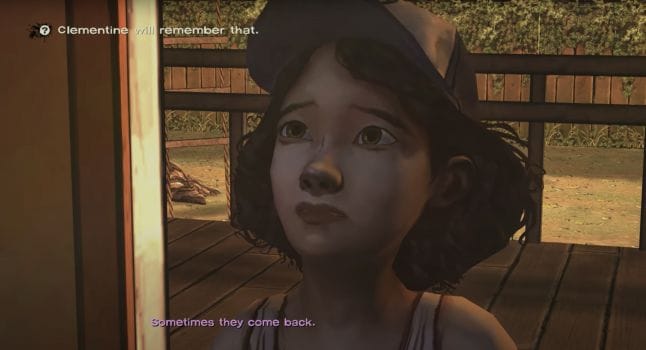
For the sake of setting a definition of a choices matter game, here’s my view: Games intended to fit within this subgenre don’t only involve branching narratives based on player interaction, they also communicate how those choices affect gameplay in real-time. For instance, the popular Walking Dead games developed by TellTale would show players the consequence of their choices in the upper right-hand corner. “Clementine will remember that” indicates to the audience that their recent choice might have pivotal narrative outcomes.
Though this convention has been emulated and adapted by other narrative designers and writers it unfortunately diminishes the power of nuance within interactive storytelling. By overtly validating a player’s choice as “mattering” you unintentionally subvert their agency. Ironically, “choices matter” games attempt to leverage players choices by magnifying their actions, but I’d argue that this design results in the opposite effect. This approach quantifies narrative, reducing storytelling to a number-crunching mechanic equivalent to hit-points or high score.
In The Last Survey, you play as a geologist returning from a year-long global survey of rare-earth mining operations for a Brazil-based magnate. Your survey produces some dire results, including the realization that Earth’s mineral supply is currently being outpaced by skyrocketing demand. In order to avert this crisis, you bring your findings back to your employer, CEO Victor Ferreria, and argue your case for curbing production. The ensuing conversation contains moments where the player is asked to choose between two options, uncertain of how your interlocutor will respond.
The process of writing The Last Survey started in Twine, with the original designs being much more “choice-heavy;” veritably every other screen was a moment for the player to choose a dialog option or to examine a detail of your report. But this felt too pedantic and ultimately started sounding preachy. The protagonist’s argument sounded more like an admonishment rather than a conversation.
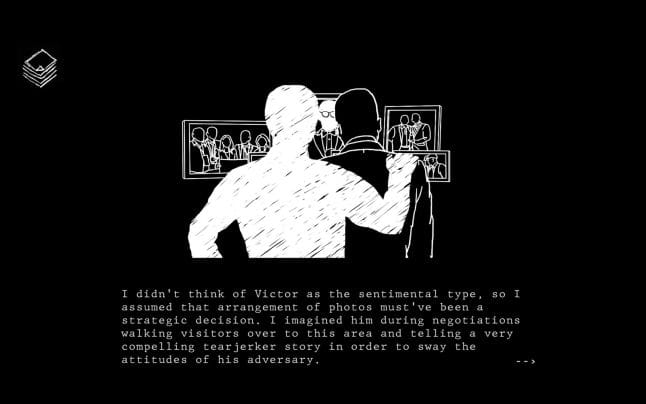
Although I wanted to impress upon players that Victor’s bottom-line-above-all-else way of thinking was anathema to global sustainability, I didn’t want that message to be too heavy-handed. I pulled upon my own experience as a contract worker interacting with C-level executives and realized that the main character—though compelled to act—wouldn’t storm Victor’s office and be so demanding or forthright. Besides, the protagonist was part of the system they were critiquing, and it didn’t feel appropriate (or convincing) to write them as having any higher moral authority.
To avoid these concerns, I scaled back player-choice and made the writing much more of an internal monologue; crafting the geologist with a self-reflective tone, leading way to questions of the players own culpability within capitalism (or other unequal systems of power). Though the choices became sparser, their impact was more meaningful for the narrative design I wanted. From this script I designed a mechanic that would track these choices and change the way Victor would respond to you, deciding whether one could continue their appeal.
However, what I found was that this design—regardless of following what I thought were typical conventions within branching narrative games—did not truly adhere to the “choices-matter” genre that I outlined above. There are no graphical indications after a player makes a choice that “Victor is displeased.” Instead, the consequences of your choices are communicated within the text itself. If you’ve chosen an option that upsets Victor, the narrative branches show that your choice was a miscalculation of the situation. If you make too many of these “bad” choices you’re asked to leave (resulting in a game-over).
Because The Last Survey doesn’t provide literal (and out-of-game) feedback to the player about their choices, my game does not fit the expectations players have grown to demand from “choice matters”-style games that we see today. During a back-and-forth with a Steam Curator who had early access to the game I asked why they felt the game was improperly labeled and they provided two reasons: 1) The Last Survey didn’t immediately communicate that choices had direct consequences and 2) Regardless of choice, they game didn’t provide much opportunity for replay value.
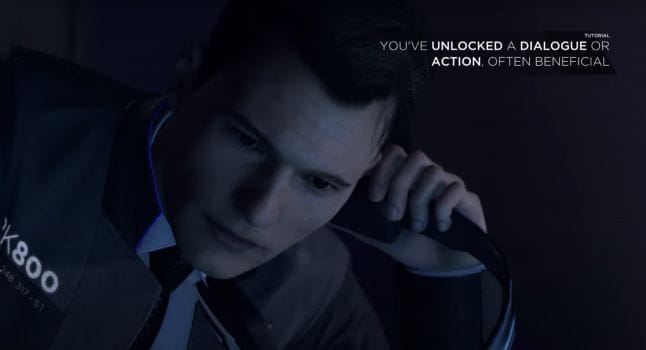
This second criteria troubles me as a writer and game designer; doubly so because other game makers (particularly larger studios) go out of their way to maximize replay-ability as a metric for measuring successful narrative design. David Cage, lead writer of Detroit: Become Human, said that the motivation for designing their “flowchart” mechanic—a visual depiction of the story path including options a player missed—was not only a way to honor the work of his staff, but also because “we wanted real choices with real consequences.”
But to me this makes for dull narrative design. All choices are real, even when players make choices that the designer never intended. All choices have consequences, even when the outcome of a choice doesn’t provide immediate feedback. By explicitly outlining a player’s actions—and quantifying their agency against a static sense of morality—interactive narrative becomes stripped down to calculable blocks of text. Where’s the subtlety and poetry in that?
Nicholas O’Brien (@EssayGames) is an artist making video games and digital animations addressing civic history, urban infrastructure, and overlooked narratives of labor. Based in Brooklyn he is an Assistant Professor of Game Design at Stevens Institute of Technology.